
Portion Control for Diabetes: The Science
Mastering the precise discipline of portion control for diabetes management is the absolute defining law of metabolic biochemistry. In my 30 years of clinical legacy in Ahmedabad, I have cross-verified thousands of traditional Indian dietary charts. The data reveals a standard behavioral error: patients frequently eliminate refined white sugar but dramatically overeat healthy complex carbohydrates like whole wheat rotis, brown rice, millets, and excessive nuts. The biological reality is that an energy surplus, even from the cleanest organic sources, will inevitably overwhelm your cellular capacity and worsen insulin resistance.
At DEFEAT DIABETESE, we approach disease reversal through raw physiological logic. To win this ek yuddh diabetese viruddh, we must understand the cellular limits of our organs and learn how managing volume protects our pancreas, steering our population safely toward our grand Vision 2040 milestones.
1. The Cellular Overflow: Understanding Adipose Tissue Saturation
The primary molecular reason behind prioritizing portion sizes lies in preventing what medicine terms “ectopic fat deposition.”
-
The Safe Storage Limit: Your subcutaneous fat tissue (the fat layer right underneath your skin) acts as a safe, designated biological warehouse to store energy.
-
The Spillover Effect: When you consume food portions that exceed your body’s immediate metabolic requirements, your subcutaneous fat cells hit their absolute storage limit and expand to their maximum size.
-
The Visceral Suffocation: Any extra calories consumed after this saturation point spill straight into your vital internal organs—packing tightly inside your liver and around your pancreatic beta-cells. This visceral fat accumulation is the absolute Insulin Resistance Root Cause, jamming your cellular locks completely.
2. Flattening the Glycemic Load: Sizing the Carbohydrate Influx
Many individuals look only at the Glycemic Index (GI) of a food item, completely ignoring its Glycemic Load (GL), which depends entirely on portion size.
-
GI vs. GL Reality: Brown rice or multi-grain rotis have a slightly lower Glycemic Index than refined white flour, meaning they break down into glucose a bit more gradually. However, if you eat a massive portion of brown rice, the total volume of glucose hitting your bloodstream is still exceptionally high.
-
Pancreatic Relief: Maintaining a strict, optimized portion size lowers the overall Glycemic Load of the meal. This ensures that glucose enters the blood as a slow, steady trickle rather than a massive wave, preventing post-meal toxic surges and shielding your pancreas from heavy strain.
3. The Satiety Lag: Hormonal Delay and Leptin Reset
One of the greatest biological benefits of portion management is its long-term effect on resetting your body’s natural hunger signaling hormones.Portion control for diabetes
-
The 20-Minute Delay: When you eat, your stomach walls stretch, signaling the release of satiety hormones like Leptin and Peptide YY (PYY) to tell your brain you are full. However, this complex hormonal transmission loop takes approximately 15 to 20 minutes to process fully.Portion control for diabetes
-
The Overeating Trap: If your plate portions are too large, you will rapidly consume a massive caloric load before your brain even registers the fullness signal. Choosing smaller, controlled portions allows your digestive tract to communicate effectively with your nervous system, preventing the development of leptin resistance.
4. Tracking Metabolic Efficiency via Clinical Analytics
At Defeat Diabetese, we completely eliminate guesswork by aligning your portion architecture with continuous laboratory tracking.Portion control for diabetes
-
Data Over Trends: We don’t just guess your macro requirements. We evaluate your baseline numbers by running detailed diagnostic profiles—including Fasting Insulin levels, C-Peptide lines to measure functional pancreatic health, and lipid particle arrays.Portion control for diabetes
-
The Dashboard Mapping: By consolidating these metabolic metrics onto your Unified Health Dashboard, our clinical team monitors exactly how your cellular sensitivity recovers as you balance your energy inputs, enabling us to safely taper off medications under Dr. Prakash Kurmi’s legacy.Portion control for diabetes
5. 5 Rules to Master Portion Control in Your Remission Journey
To systematically strip away visceral fat and restore your native metabolic flexibility, implement this plate management protocol strictly:
-
Enforce the Plate Sequencing Blueprint: Never look at your food as a mixed pile. Always consume your rich dietary fiber (steamed or raw greens) and clean protein (fresh paneer, sprouted lentils) first. Only after you have finished these sections should you touch small, controlled portions of complex carbohydrates. This sequencing establishes a physical mesh in your gut that slows down carbohydrate absorption.
-
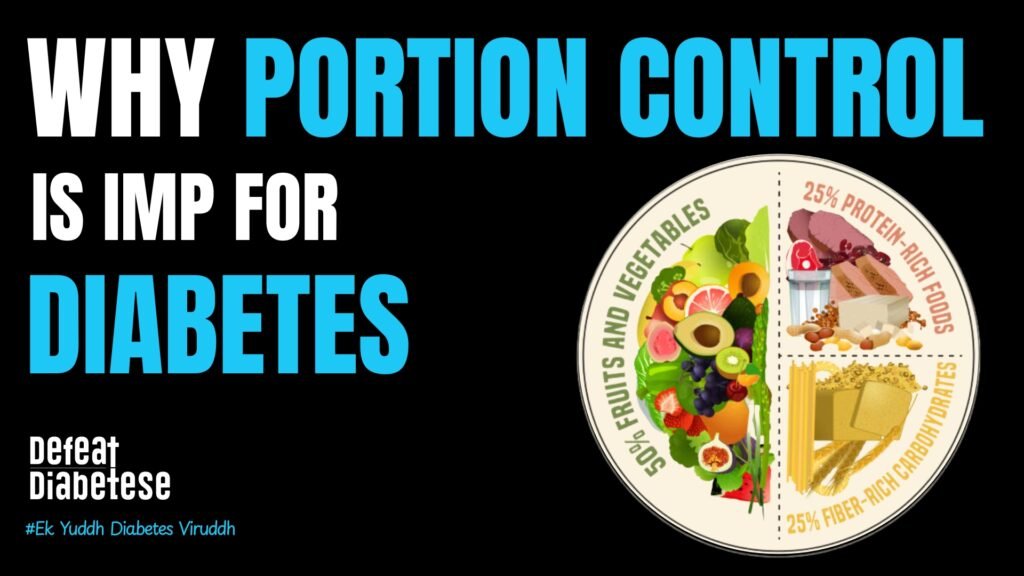
Utilize Visual Plate Sizing: Do not guess your food weights. Use the globally standardized visual metric: half of your standard plate must be filled with non-starchy fiber, one-quarter must consist of clean protein, and only the remaining one-quarter can contain complex carbs.Portion control for diabetes
-
Ditch the Direct-from-Packet Habit: Never consume nuts, roasted seeds, or low-glycemic snacks directly from large containers or commercial packets. Your brain cannot track volume without visual boundaries. Always serve a measured quantity into a small bowl before eating.Portion control for diabetes
-
Slow Down Your Mastication Rate: Chew every single bite of food at least 25 to 30 times before swallowing. Slowing down your physical eating speed allows your gut’s natural incretin hormones to catch up with your brain’s satiety centers, naturally satisfying your appetite with smaller portions.Portion control for diabetes
-
Audit Trends via the Digital Dashboard: Keep an accurate log of your macro choices and baseline fasting profiles on your digital health dashboard. This allows our medical team at Shivam Hospital to fine-tune your caloric distribution safely based on your hard metabolic data.Portion control for diabetes
6. Frequently Asked Questions (FAQs)
Q1: Can eating too small a portion stall my diabetes reversal?
Yes. If you drastically starve your body through extreme, unscientific portion restrictions, your body enters a protective “starvation mode.” This slows down your metabolic rate and catabolizes precious skeletal muscle tissue—your primary “sugar sponges”—which ultimately worsens insulin resistance. Balance is key.
Q2: How do I manage portion control when dining out or at social events?
The simplest rule is the “One-Plate Rule.” Fill your plate once following the correct sequencing (fiber and protein first) and refuse all secondary helpings. Avoid liquid calories like fruit juices, mocktails, or sodas completely.
Q3: How does the Defeat Diabetese framework track food portions?
Backed by 30 years of medical wisdom, we reject mindless calorie-counting applications. We analyze how total food volumes shift your specific cellular parameters, tailoring your daily macronutrient layout to fit your unique blood chemistry profiles safely and logically.
Conclusion: Command Your Plate, Heal Your Cells
Prioritizing portion control for diabetes proves that successful remission is dictated by precision, not restriction. Healthy food only yields healthy results when it matches your body’s structural processing limits. By managing your food volumes logically and tracking your metrics continuously, you can easily unburden your liver and pancreas permanently. Let us stand undefeated in this ek yuddh diabetese viruddh to secure our ultimate Vision 2040 milestones.
ek yuddh diabetese viruddh. Visit us: www.defeatdiabetese.com