
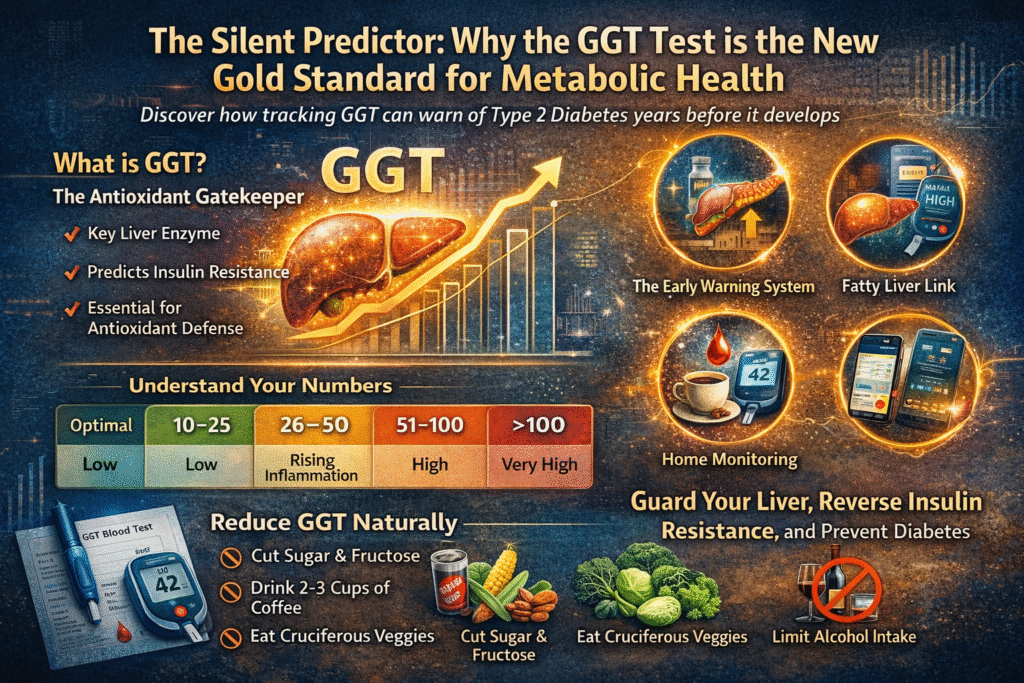
The Silent Predictor: Why the GGT Test is the New Gold Standard for Metabolic Health
For decades, the conversation around diabetes has been dominated by two numbers: Glucose and A1c. We’ve been taught that if these two are under control, we’re winning the battle.
But what if I told you there is a “whispering” enzyme in your liver that can predict Type 2 Diabetes years before your blood sugar even budges?
Enter the GGT (Gamma-Glutamyl Transferase) test. In 2026, this isn’t just a “liver test” for heavy drinkers anymore. It has become a crucial metabolic dashboard for anyone looking to optimize their health, reverse insulin resistance, and stay ahead of chronic disease.
What is GGT? (The Antioxidant Gatekeeper)
Gamma-Glutamyl Transferase (GGT) is an enzyme found primarily in your liver, but also in your kidneys and pancreas. Its primary biological job is to help transport molecules across cell membranes and, most importantly, to maintain the body’s levels of Glutathione.
Glutathione is your “Master Antioxidant.” Think of it as the cellular cleanup crew that mops up oxidative stress and inflammation.
The Leakage Theory: When your liver is healthy and unstressed, very little GGT escapes into your bloodstream. However, when your liver cells are under siege—from excess sugar, processed fats, or environmental toxins—they begin to “leak” GGT. In 2026, we now recognize that a rising GGT score is actually an SOS signal from your metabolism.
The 2026 Connection: GGT and Diabetes
Why should a person concerned about diabetes care about a liver enzyme? Because the liver is the “engine room” of your metabolism.
1. The Early Warning System
Recent longitudinal studies in 2025 and 2024 have confirmed that GGT levels in the “high-normal” range are a stronger predictor of future Type 2 Diabetes than fasting glucose itself. If your GGT is creeping up, it means your body is burning through its antioxidant stores to fight off rising inflammation. This is the “Pre-Prediabetes” stage.
2. Fatty Liver and Insulin Resistance
There is a massive overlap between MAFLD (Metabolic Associated Fatty Liver Disease) and Type 2 Diabetes. When the liver becomes “fatty,” it becomes deaf to the signals of insulin. This causes the liver to dump sugar into the blood even when you haven’t eaten. High GGT is often the first clinical sign that your liver is accumulating fat, even if your weight hasn’t changed.
3. The Pancreas Connection
Recent research suggests that GGT isn’t just a bystander; it may actually interfere with how the beta cells in your pancreas release insulin. High levels of circulating GGT create an environment of oxidative stress that makes it harder for your body to process carbohydrates efficiently.
Understanding Your Numbers: The “Optimal” vs. “Normal” Gap
This is where most people (and some doctors) miss the mark. Standard laboratory “normal” ranges are often based on the average of the population—and the average person in 2026 is metabolically unwell.
To achieve 100/100 health, you need to look at Optimal Ranges:
| Risk Level | GGT Range (U/L) | Metabolic Status |
| Optimal | 10 – 25 | Low oxidative stress; High insulin sensitivity. |
| Caution | 26 – 50 | Rising inflammation; Possible early fatty liver. |
| High Risk | 51 – 100 | High risk for Metabolic Syndrome and T2D. |
| Clinical | >100 | Active liver damage or bile duct obstruction. |
Note: Always consult with a healthcare professional to interpret your specific lab results in the context of your full medical history.
2026 Tech: Monitoring GGT at Home
The biggest change in diabetes care this year is the democratization of data. You no longer have to wait for an annual physical to check your GGT.
-
Metabolic Health Subscriptions: Wearable tech companies now offer quarterly “at-home” blood panels. You can prick your finger, mail a card, and see your GGT levels alongside your CGM (Continuous Glucose Monitor) data on your smartphone.
-
AI Correlations: Apps like NutriSense and Levels now use AI to correlate your glucose spikes with your GGT trends. For example, if your GGT is high, the AI might explain why your morning “Dawn Phenomenon” (high morning blood sugar) is getting worse.
How to Lower Your GGT Naturally
The good news? GGT is highly “plastic”—it responds quickly to lifestyle changes.
-
Cut the Fructose: Unlike glucose, fructose is processed almost entirely in the liver. High-fructose corn syrup is the fastest way to spike GGT.
-
The Coffee Paradox: Modern meta-analyses show that 2–3 cups of black coffee daily is one of the most effective ways to lower GGT and protect the liver.
-
Magnesium & Sulfur: Eat more cruciferous vegetables (broccoli, kale, Brussels sprouts). These provide the sulfur needed to produce Glutathione, which naturally brings GGT levels down.
-
Watch the “Hidden” Alcohol: Even moderate “social” drinking can keep GGT elevated, masking your true metabolic progress. Try a “Liver Reset” for 30 days to see your true baseline.
GGT Test: The Silent Predictor of Metabolic Health
Many people focused on diabetes management look solely at A1c, but the GGT test is actually one of the most powerful early-warning tools available in 2026. If you want to understand your true risk of insulin resistance, you need to look at what your liver is telling you. The GGT test (Gamma-Glutamyl Transferase) measures a specific liver enzyme that leaks into your blood when your metabolism is under stress.
Why the GGT Test is Critical for Diabetes Prevention
The reason the GGT test is gaining so much traction in modern diabetes care is its ability to predict Type 2 Diabetes years before blood sugar rises. While a standard metabolic panel might include this enzyme, many patients don’t realize that a “high-normal” GGT test result is often the first sign of a fatty liver.
When you monitor your health, using a GGT test alongside your CGM data allows for a 360-degree view of your metabolic engine. By keeping your GGT test levels in the optimal range (10-25 U/L), you are effectively protecting your pancreas from oxidative stress.
Conclusion: The Big Picture
In the era of precision medicine, we can no longer afford to look at organs in isolation. Your liver and your blood sugar are partners. By monitoring your GGT levels, you are looking under the hood of your metabolism.
Don’t wait for your A1c to hit the “danger zone.” Check your GGT, protect your liver, and take control of your metabolic future today.