India’s Obesity Trap: Why 84% Fail and How Defeating Diabetes is the Secret to Weight Loss
India’s Obesity Trap aaj ek bada sankat ban chuka hai. Haal hi mein aayi ek report ke mutabiq, 84% log vajan ghatane ki koshish karte hain par India’s Obesity Trap se nikal nahi paate…
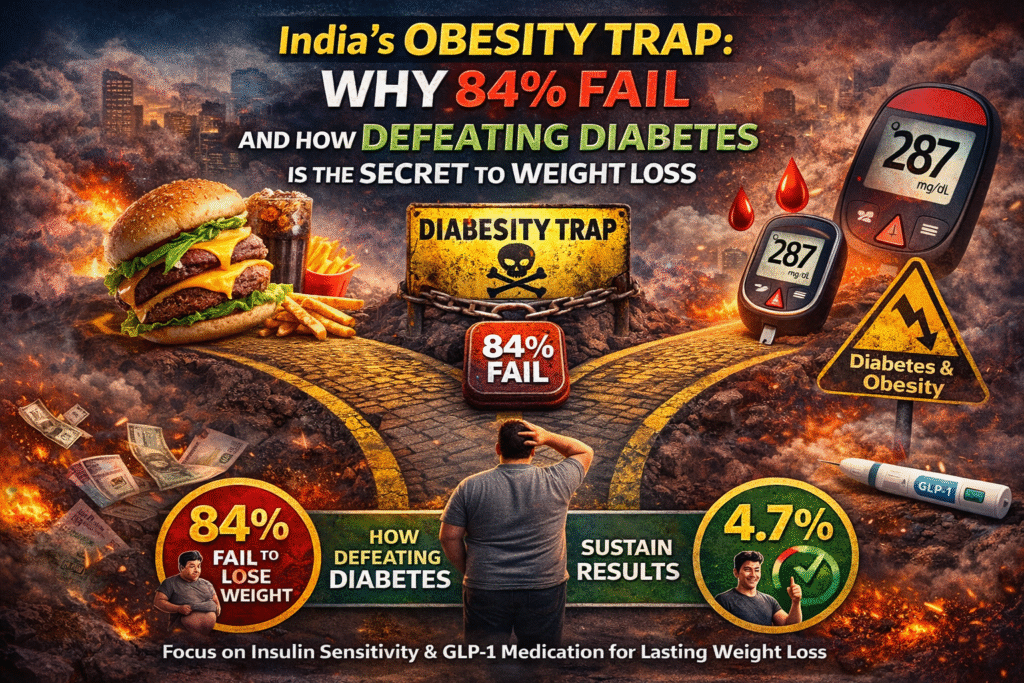
For decades, the prevailing narrative around weight in India has been one of personal willpower. We viewed a bulging waistline as a “lifestyle flaw”—a sign of laziness or indulgence. However, a groundbreaking white paper published in Clinical Obesity has shattered that myth. The data reveals a national emergency: 84% of surveyed Indians have attempted to lose weight, yet a mere 4.7% sustained results for more than a year.
This isn’t just a failure of diets; it’s a biological trap. To escape it, we must understand the “Diabesity” cycle—and realize that the journey to a leaner body often starts with the mission to defeat diabetes.
1. Redefining the Battle: Obesity as a Chronic Disease
India’s Obesity Trap – Obesity is a complex condition influenced by:
-
Genetics: Our bodies are evolutionarily primed to store fat.
-
Hormonal Imbalances: Signals like leptin (fullness) and ghrelin (hunger) get “broken” in obese individuals.
-
The Environment: In India, ultra-processed “junk” food is often cheaper and more accessible than fresh produce.
2. The Deadly Link: How Obesity Fuels Diabetes
The report highlights that abdominal obesity affects over 35 crore Indians. This isn’t just “extra weight”; it is metabolically active tissue that creates Insulin Resistance. In a healthy body, insulin acts as a key to let sugar into your cells for energy. In a body trapped by obesity, the “locks” (cells) become rusty. The sugar stays in the blood, the pancreas pumps out more insulin to compensate, and eventually, the system crashes into Type 2 Diabetes. In 2019 alone, obesity-linked diseases were associated with 5.79 lakh adult deaths in India.
3. The Reverse Strategy: How Defeating Diabetes Reduces Weight
Most people think: “I will lose weight to fix my diabetes.” While true, the modern medical approach is often the reverse: “By managing and defeating the diabetic state, your body finally becomes capable of losing weight.”
Here is how controlling diabetes helps you shed pounds:
A. Fixing the “Fat Storage” Hormone
Insulin is the body’s primary fat-storage hormone. When you have out-of-control diabetes (high insulin levels), your body is in “permanent storage mode.” It is biologically impossible to burn fat when insulin levels are chronically high. By defeating diabetes—through medication, low-glycemic diets, and timing—you lower your insulin levels, finally “unlocking” your fat stores to be used as fuel.
B. Stabilizing Hunger Cravings
Diabetes causes “blood sugar rollercoasters.” When your sugar crashes, your brain screams for sugar and carbs, leading to binge eating. By stabilizing your glucose (defeating the diabetic spikes), you eliminate the physiological urge to overeat.
C. The Role of Modern “Double-Agent” Medications
Newer treatments for diabetes, such as GLP-1 receptor analogues, are revolutionizing healthcare. These medications treat diabetes by improving insulin secretion while simultaneously slowing gastric emptying and signaling the brain to feel full. This is a dual-threat approach: you defeat diabetes, and as a direct side effect, the weight begins to drop.
4. The Economic and Social Toll
The “India’s Obesity Trap ” isn’t just a health issue; it’s a financial ticking time bomb. The economic burden in India was ₹2,50,000 crore in 2019 and is projected to hit ₹72 lakh crore by 2060.
Beyond money, the mental health cost is devastating. The report notes that obesity fuels depression and social stigma. When 84% of people try to lose weight and fail, they fall into a cycle of shame. Breaking this cycle requires moving away from “dieting” and toward metabolic health.
5. A National Framework for Change
The researchers called for a formal recognition of obesity under India’s national non-communicable disease framework. This includes:
-
Subsidies for Nutrition: Making fruits and vegetables cheaper than ultra-processed snacks.
-
Urban Redesign: Creating cities that encourage walking and physical activity.
-
Affordable Medicine: Ensuring that weight-loss and anti-diabetic drugs are available as affordable generics.
6. Your Action Plan to Break the Trap
India’s Obesity Trap To get out of the 84% who fail and into the 4.7% who succeed, stop looking at the scale and start looking at your metabolism.
-
Consult a Professional: Stop “DIY” dieting. Over a third of Indians never speak to a doctor about their weight—don’t be one of them.
-
Focus on Insulin Sensitivity: Prioritize strength training and high-fiber foods to make your body more responsive to insulin.
-
Monitor Your Glucose: Even if you aren’t diabetic yet, understanding how your blood sugar reacts to food is the key to weight control.
Strategy to Defeat Diabetes: A Three-Pronged Approach
If we are to escape this trap, the strategy must move beyond individual effort and into the realm of policy and science.
| Pillar | Action Needed |
| Medical | Access to GLP-1 receptor analogues and affordable generics. |
| Environmental | Urban redesign to encourage walking and safer public spaces. |
| Nutritional | Subsidies for fruits/vegetables to make healthy food cheaper than junk food.
|
Conclusion: A Call to Action
The “India’s Obesity Trap ” is a wake-up call. We cannot exercise our way out of a systemic problem, nor can we “willpower” our way out of a biological disease. Defeating diabetes requires us to treat weight management with the same medical seriousness as any other chronic illness.
It is time to stop the blame game and start the healing process—for our waistlines, our blood sugar levels, and our future.
The “Obesity Trap” is real, but it is not a life sentence. By recognizing obesity as a chronic disease and understanding that defeating diabetes is a primary driver of weight loss, we can reclaim our health. It’s time to stop fighting our bodies and start fixing the underlying science.