How CGM is Changing Diabetes Management: The Revolution
Understanding how CGM is changing diabetes management is essential for appreciating the modern shift from reactive disease control to high-precision metabolic medicine. In my 30 years of clinical legacy at Shivam Hospital in Ahmedabad, the biggest handicap doctors faced was the lack of continuous, real-time data. Traditional HbA1c tests only provided a 90-day average, completely hiding extreme dangerous sugar spikes and midnight drops. A patient could have a “normal” HbA1c of 6.5% while experiencing wild daily sugar rollercoasters that silently damaged their micro-vascular organs.
At DEFEAT DIABETESE, we embrace technological innovation through strict physiological logic. To win this ek yuddh diabetese viruddh, we leverage Continuous Glucose Monitoring (CGM) data to replace clinical guesswork with absolute data-driven clarity, keeping us firmly aligned with our Vision 2040 milestones.
1. From Static Snapshots to Full Dynamic Movies
The primary reason why CGM sensors are transforming clinical practice is the transition from isolated data points to continuous, live streams.
-
The Finger-Prick Blindspot: A standard finger-prick test gives a single number at a single second. It fails to show whether your blood sugar is rapidly rising, stabilizing, or crashing downward.
-
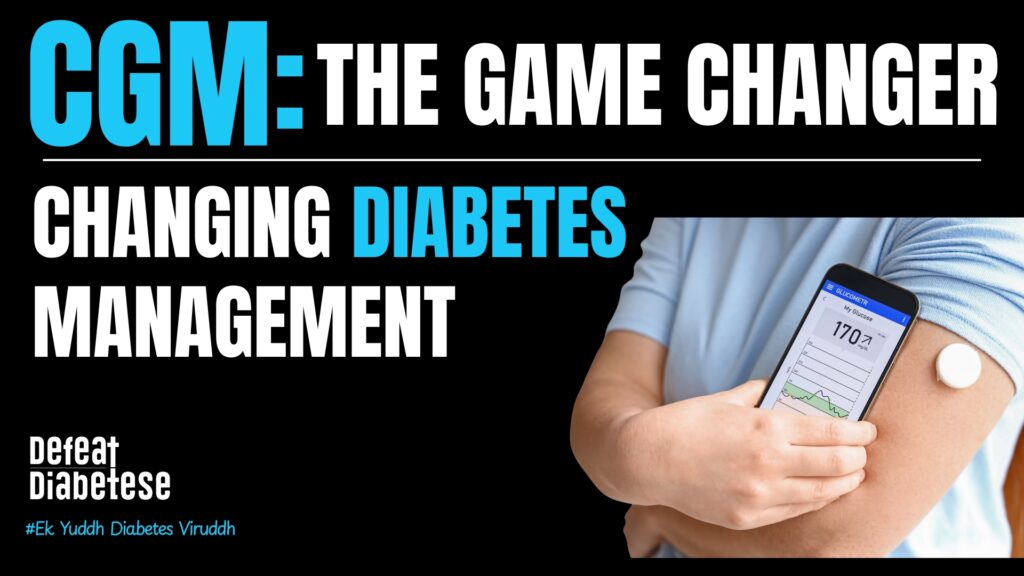
The Continuous Stream: A CGM sensor worn under the skin measures interstitial fluid glucose continuously, generating up to 288 readings a day. It overlays these data points into a clear trend line with direction arrows, allowing both the doctor and patient to see the immediate biological impact of every meal, exercise session, and stress event.
2. Establishing the New Gold Standard: Time in Range (TIR)
CGM technology has introduced a far more accurate clinical metric than basic HbA1c: Time in Range (TIR).
-
Understanding TIR: Time in Range measures the exact percentage of hours in a day that a patient’s glucose stays within a safe, healthy target window.
-
Why Doctors Love TIR: Two different patients can have the exact same HbA1c of 7.0%. However, Patient A might stay in target range 85% of the day smoothly, while Patient B suffers severe high spikes followed by dangerous midnight crashes. TIR allows doctors to identify Patient B’s hidden vulnerability instantly and correct it.How CGM is changing diabetes management
3. Eliminating Hypoglycemia and Uncovering the Dawn Phenomenon
For a clinician, managing a patient’s high sugar is important, but preventing sudden, dangerous low sugar crashes (hypoglycemia) is a matter of life and death.How CGM is changing diabetes management
-
Nocturnal Detection: Many diabetic patients experience severe sugar crashes around 3:00 AM while sleeping (nocturnal hypoglycemia), waking up with unexplained headaches or fatigue. CGM sensors track nighttime trends seamlessly, alerting doctors to adjust evening basal insulin doses accurately.How CGM is changing diabetes management
-
Decoding the Dawn Phenomenon: CGM data clearly distinguishes between a late-night rebound spike (Somogyi effect) and a stress-induced morning liver glucose dump (Dawn Phenomenon), enabling targeted medical intervention rather than blind drug increases.How CGM is changing diabetes management
4. Hyper-Personalized Nutritional Auditing for Patients
Every human metabolism reacts differently to carbohydrates. A food item that causes a mild rise in one person might trigger a severe spike in another.
-
Bio-Feedback Learning: When a patient wears a CGM sensor, they see the direct real-time consequence of eating a bowl of rice versus a protein-first meal. This instant feedback loop retrains their habits faster than any written diet chart.How CGM is changing diabetes management
-
Precision Macro Tuning: By viewing these real-time trend lines uploaded directly to our clinical dashboard, our medical team can precisely adjust macro ratios, meal timing, and fiber pre-loads to flatten glucose curves effortlessly.How CGM is changing diabetes management
5. 5 Ways CGM Data Empowers Your Doctor’s Treatment
To understand how Continuous Glucose Monitoring makes diabetes management significantly easier and more effective for your clinical team, look at these 5 parameters:How CGM is changing diabetes management
-
Eliminates Patient Memory Bias: Doctors no longer have to rely on manual paper logbooks or patient memory, which are often incomplete or inaccurate.How CGM is changing diabetes management
-
Enables Safe Drug Tapering: By viewing 24-hour glucose stability, clinicians can safely taper down complex insulin or oral drug dosages without fear of sudden rebound spikes.
-
Tracks Stress and Sleep Impact: CGM graphs clearly show how a bad night’s sleep or corporate work stress triggers sustained cortisol spikes, allowing the doctor to address lifestyle factors alongside nutrition.
-
Optimizes Exercise Timing: Real-time trend lines show doctors exactly how post-meal walks or resistance training sessions clear glucose, helping tailor exercise timing for maximum efficiency.
-
Accelerates True Remission: Having access to continuous data allows our team at Shivam Hospital to unjam cellular locks systematically, driving patients safely toward long-term, drug-free remission.
6. Frequently Asked Questions (FAQs)
Q1: Does a CGM sensor measure blood sugar directly from the blood?
No. A CGM sensor sits on the skin and uses a tiny filament to measure glucose in the interstitial fluid—the fluid surrounding your cellular tissue. Because glucose moves from the blood into the interstitial fluid, there is a minor 5 to 10-minute lag time compared to direct blood testing, but the overall trend lines are remarkably accurate.
Q2: Does wearing a CGM hurt or interfere with daily activities?
Not at all. Modern CGM sensors are small, water-resistant, and applied virtually painlessly on the back of the upper arm. You can shower, exercise, and sleep comfortably while wearing one.
Q3: How does the Defeat Diabetese ecosystem utilize CGM technology?
Backed by 30 years of medical wisdom, we merge real-time CGM data with targeted hormone laboratory profiles on our Unified Health Dashboard. This allows Dr. Prakash Kurmi and our medical team to build a data-driven, highly personalized perimeter for your remission journey.How CGM is changing diabetes management
Conclusion: Precision Over Guesswork
Observing how CGM is changing diabetes management proves that data is the ultimate key to metabolic freedom. By replacing sporadic finger-pricks with continuous biological clarity, doctors can treat the root cause of insulin resistance with absolute medical accuracy. Let us leverage modern science to win this ek yuddh diabetese viruddh and achieve our landmark Vision 2040 targets.How CGM is changing diabetes management
Visit us: www.defeatdiabetese.com