
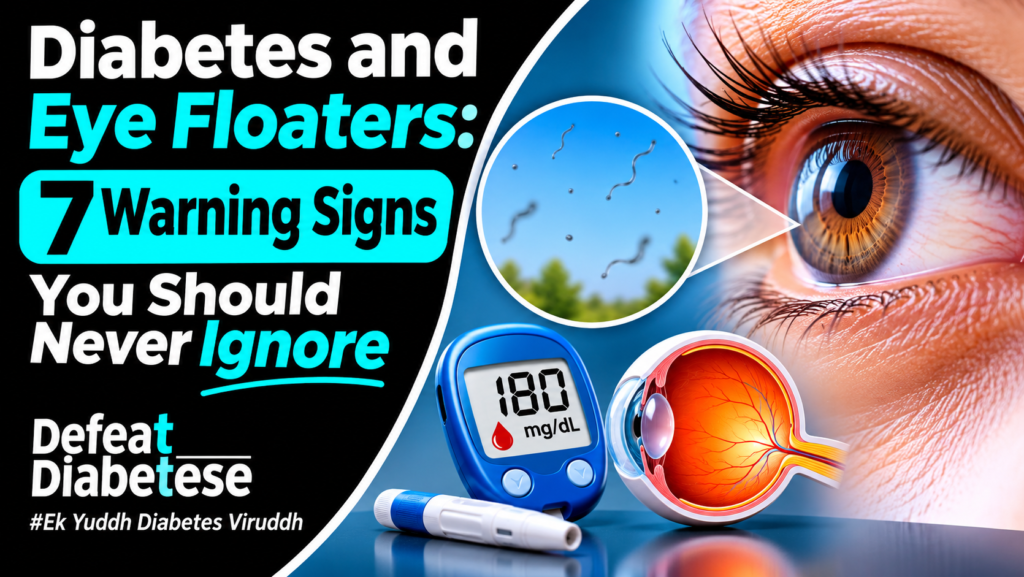
Diabetes and Eye Floaters: 7 Warning Signs You Should Never Ignore
Introduction
Have you ever noticed tiny black spots, floating threads, cobweb-like shapes, or moving shadows in your vision? These visual disturbances are commonly known as eye floaters.
Eye floaters can appear when looking at a bright sky, white wall, or computer screen. They may move when your eyes move and seem to drift away when you try to focus directly on them.
In many cases, floaters are caused by normal age-related changes inside the eye and are harmless. However, for people living with diabetes, new or sudden floaters deserve particular attention because they can sometimes indicate bleeding inside the eye or other serious retinal complications.
Diabetes can damage the small blood vessels in the retina, the light-sensitive tissue at the back of the eye. Over time, this damage may lead to diabetic retinopathy, which can threaten vision if not detected and managed appropriately.
Understanding the connection between diabetes and eye floaters can help you recognise potentially serious symptoms and seek timely medical care.
In this article, we explain what eye floaters are, why they may occur in people with diabetes, seven warning signs you should never ignore, available treatments, and practical steps to protect your eyesight.
What Are Eye Floaters?
Eye floaters are small shapes that appear to move across your field of vision.
They may look like:
- Tiny black or grey dots.
- Thin threads or squiggly lines.
- Cobweb-like patterns.
- Small rings or circular shadows.
- Cloudy patches that drift when your eyes move.
Floaters usually originate in the vitreous, a clear, gel-like substance that fills the space between the lens and the retina.
As people age, the vitreous can gradually change consistency and develop small clumps of collagen fibres. These clumps cast shadows onto the retina, creating the appearance of floating objects.
This process is commonly associated with posterior vitreous detachment, in which the vitreous separates from the retina.
Most age-related floaters are not caused by diabetes.
However, a sudden increase in floaters can sometimes occur when the vitreous pulls on the retina, causing a retinal tear, or when bleeding enters the vitreous cavity.
Because diabetes can increase the risk of certain retinal complications, new floaters should not be automatically dismissed as harmless.
How Are Diabetes and Eye Floaters Connected?
Diabetes can affect the eyes primarily through damage to small retinal blood vessels.
When blood glucose levels remain elevated over time, the risk of diabetic retinopathy increases.
Diabetic retinopathy develops when retinal blood vessels become damaged, leak fluid, or become blocked.
In more advanced stages, the retina may develop abnormal new blood vessels, a condition known as proliferative diabetic retinopathy.
These new vessels are fragile and can bleed into the vitreous.
This bleeding is called vitreous haemorrhage and may cause sudden floaters, dark spots, cloudy vision, or significant visual loss.
Scar tissue associated with proliferative diabetic retinopathy can also pull on the retina, potentially causing tractional retinal detachment.
Importantly, not every person with diabetes who experiences floaters has diabetic retinopathy.
Floaters can also result from ageing, posterior vitreous detachment, retinal tears, inflammation, and other eye conditions.
A comprehensive dilated eye examination is necessary to determine the underlying cause.
7 Warning Signs of Eye Floaters You Should Never Ignore
1. A Sudden Increase in Eye Floaters
A few longstanding floaters that remain unchanged may be relatively harmless.
However, suddenly noticing many new spots, threads, or dark specks can be a warning sign.
A rapid increase in floaters may indicate bleeding inside the eye, a retinal tear, or changes involving the vitreous.
In people with diabetic retinopathy, fragile abnormal retinal blood vessels may rupture and cause vitreous haemorrhage.
This can produce numerous dark spots that appear unexpectedly.
Warning signs to watch for:
- Many new black dots appearing suddenly.
- A sudden shower of floating spots.
- Rapidly increasing cobweb-like shapes.
- New floaters accompanied by cloudy vision.
What should you do?
Seek urgent assessment by an ophthalmologist, ideally the same day.
Do not wait for the floaters to disappear on their own.
A sudden shower of floaters may require emergency evaluation to rule out a retinal tear or detachment.
2. Flashes of Light Along With Floaters
Seeing flashes of light together with new floaters is another important warning sign.
These flashes may resemble brief lightning streaks, camera flashes, or flickering lights, especially toward the side of your vision.
They can occur when the vitreous pulls on the retina.
Although vitreous separation is often age-related, the pulling process can occasionally create a retinal tear.
If fluid passes through a retinal tear, it may lead to retinal detachment.
Retinal detachment is a medical emergency because delayed treatment can result in permanent vision loss.
Warning signs to watch for:
- Sudden flashes of light.
- New floaters appearing with flashes.
- Repeated peripheral light streaks.
- Flashes accompanied by reduced vision.
What should you do?
Arrange immediate ophthalmic evaluation.
If symptoms begin suddenly, especially with new floaters or a visual shadow, seek emergency eye care rather than waiting for a routine appointment.
3. Dark Shadows or a Curtain Across Your Vision
A dark shadow or curtain moving across part of your visual field is one of the most serious symptoms associated with retinal detachment.
The shadow may begin in the peripheral vision and gradually extend toward the centre.
In people with advanced diabetic retinopathy, scar tissue may pull on the retina and cause tractional retinal detachment.
Other types of retinal detachment may occur when a retinal tear allows fluid to collect beneath the retina.
Both situations can threaten eyesight.
Warning signs to watch for:
- A dark curtain covering part of your vision.
- A growing shadow from one side.
- Sudden loss of peripheral vision.
- A missing or dark area in your visual field.
What should you do?
Seek emergency ophthalmic care immediately.
Do not drive yourself if your vision is affected.
Retinal detachment requires urgent specialist assessment, and some cases need prompt surgery to preserve vision.
4. Sudden Blurred or Cloudy Vision
Floaters may occasionally interfere with vision when they move across the visual axis.
However, sudden or significant blurring can indicate a more serious problem.
Vitreous haemorrhage may cause the vision to appear hazy, smoky, or cloudy.
The severity depends on how much blood enters the vitreous cavity.
Some people notice a few dark spots, while others experience substantial visual obstruction.
Diabetic macular oedema and other retinal conditions can also affect visual clarity, although they do not necessarily cause floaters.
Warning signs to watch for:
- Sudden cloudy or smoky vision.
- Rapidly worsening visual clarity.
- Difficulty recognising faces.
- New floaters with significant blurring.
What should you do?
Obtain urgent medical assessment, particularly when blurred vision begins suddenly or occurs with new floaters.
A dilated retinal examination can help identify bleeding, retinal tears, or other complications.
5. Red or Dark Spots Appearing in Your Vision
Some people describe floaters as black dots, while others notice reddish, brownish, or dark cloud-like shapes.
These symptoms may sometimes occur when blood enters the vitreous.
In proliferative diabetic retinopathy, abnormal new retinal blood vessels can bleed.
Small haemorrhages may produce scattered spots, while larger haemorrhages can create widespread visual haze.
However, the colour or appearance of floaters alone cannot reliably identify their cause.
Warning signs to watch for:
- Sudden reddish or dark floating spots.
- New clusters of dark shapes.
- A cloudy appearance accompanied by spots.
- A noticeable change in the number or density of floaters.
What should you do?
Contact an ophthalmologist promptly for an urgent examination.
Do not attempt to diagnose vitreous bleeding based only on the appearance of the spots.
6. Floaters Accompanied by Loss of Side Vision
Peripheral vision allows you to notice objects and movement outside your direct line of sight.
New floaters accompanied by reduced peripheral vision may indicate a retinal problem.
Retinal tears and detachments can affect the visual field, sometimes beginning at the edges.
Advanced diabetic eye disease can also produce retinal complications that threaten peripheral or central vision.
Warning signs to watch for:
- Difficulty seeing objects to one side.
- A missing section of peripheral vision.
- New floaters with visual field changes.
- A shadow that gradually expands.
What should you do?
Seek emergency eye evaluation.
Loss of peripheral vision should never be considered a routine symptom of harmless floaters.
Prompt diagnosis is essential.
7. Floaters With Sudden or Significant Vision Loss
Sudden loss of vision is a serious symptom regardless of whether floaters are present.
Possible causes include vitreous haemorrhage, retinal detachment, retinal vascular disorders, and other urgent eye conditions.
In people with advanced diabetic retinopathy, bleeding or tractional retinal detachment may cause severe visual impairment.
Vision loss may occur in one eye without significant pain.
The absence of pain does not mean the condition is harmless.
Warning signs to watch for:
- Sudden major reduction in vision.
- Inability to see clearly through one eye.
- A large dark area in the visual field.
- Rapidly worsening vision accompanied by floaters.
What should you do?
Seek emergency medical or ophthalmic care immediately.
Do not wait until the next day or attempt home remedies.
Sudden vision loss can also have causes unrelated to diabetic retinopathy and always requires urgent assessment.
How Are Eye Floaters Diagnosed in People With Diabetes?
An ophthalmologist can investigate floaters through a detailed eye examination.
Dilated Eye Examination
Eye drops are used to widen the pupils, allowing the doctor to examine the retina and vitreous more thoroughly.
This helps identify retinal tears, bleeding, diabetic retinopathy, and other abnormalities.
Optical Coherence Tomography (OCT)
OCT is a non-invasive imaging test that produces detailed cross-sectional images of the retina.
It is particularly useful for evaluating diabetic macular oedema and certain retinal structural changes.
However, OCT alone does not replace a complete peripheral retinal examination when a tear or detachment is suspected.
Ocular Ultrasound
If bleeding prevents the ophthalmologist from seeing the retina clearly, an ultrasound examination may help assess the vitreous and detect certain retinal abnormalities.
Additional Retinal Imaging
Retinal photography or fluorescein angiography may be recommended to evaluate diabetic retinopathy and abnormal retinal blood vessels.
The appropriate tests depend on the symptoms and examination findings.
Can Diabetes-Related Eye Floaters Be Treated?
Treatment depends on the underlying cause.
Observation
Many ordinary age-related floaters do not require treatment.
When a retinal examination confirms that no dangerous condition is present, monitoring may be appropriate.
Retinal Laser Treatment
Laser treatment may be used for certain retinal tears or diabetic retinopathy complications.
Panretinal photocoagulation can help reduce the risk of severe vision loss in selected patients with proliferative diabetic retinopathy.
Anti-VEGF Injections
Anti-VEGF medicines may be used to treat certain complications of diabetic retinopathy.
These medicines reduce abnormal blood vessel activity and can be helpful in appropriately selected cases.
Vitrectomy Surgery
Vitrectomy is a surgical procedure that removes the vitreous gel.
It may be recommended for non-clearing vitreous haemorrhage, tractional retinal detachment, or other serious retinal complications.
The decision depends on the patient’s eye condition, symptoms, and specialist assessment.
Not all floaters require surgery.
7 Practical Tips to Protect Your Eyes With Diabetes
1. Keep Blood Sugar Within Your Individual Target Range
Long-term glucose management can help reduce the risk and progression of diabetic retinopathy.
Follow your personalised treatment plan.
2. Schedule Regular Dilated Eye Examinations
Diabetic retinopathy can develop without noticeable symptoms.
People with type 2 diabetes generally need a comprehensive eye examination at diagnosis, while people with type 1 diabetes usually begin screening within five years of diagnosis.
Follow-up frequency depends on examination findings and professional recommendations.
3. Manage Blood Pressure and Cholesterol
Blood pressure and lipid management are important parts of protecting vascular and eye health.
Follow your doctor’s advice regarding monitoring and treatment.
4. Avoid Smoking
Smoking increases cardiovascular and vascular health risks.
Quitting smoking supports overall health and diabetes management.
5. Never Ignore Sudden Visual Changes
New floaters, flashes, curtains, or sudden vision loss require urgent assessment.
Routine screening appointments are not a substitute for emergency care when these symptoms occur.
6. Follow Prescribed Diabetes Treatment
Take your medicines as directed and attend regular medical appointments.
Discuss significant glucose fluctuations with your healthcare team.
7. Maintain a Healthy Lifestyle
Balanced nutrition, suitable physical activity, adequate sleep, and regular medical follow-up can support overall diabetes care.
When Should You See an Eye Specialist?
Seek urgent same-day ophthalmic assessment if you suddenly develop new floaters, a shower of black spots, or flashes of light.
Go to emergency eye care immediately if you notice a curtain-like shadow, missing peripheral vision, or sudden significant vision loss.
Even if symptoms improve, a retinal examination may still be necessary.
For people with diabetes, regular dilated eye examinations are important because serious retinal disease can develop before symptoms become noticeable.
Frequently Asked Questions (FAQs)
1. Can diabetes cause eye floaters?
Yes. Advanced diabetic retinopathy can cause bleeding into the vitreous, producing floaters. However, many floaters are caused by normal age-related vitreous changes rather than diabetes.
2. Are eye floaters always dangerous?
No. Many floaters are harmless. However, sudden new floaters, flashes, shadows, or vision loss may indicate a retinal tear, bleeding, or detachment and require urgent examination.
3. Can high blood sugar directly cause floaters?
High blood sugar does not usually create ordinary vitreous floaters directly. Long-term elevated glucose can damage retinal blood vessels, and advanced diabetic retinopathy may cause bleeding that appears as floaters.
4. Will diabetic eye floaters disappear naturally?
Some floaters become less noticeable over time. Blood inside the vitreous may sometimes clear gradually, but the underlying cause must be evaluated and treated when necessary.
5. Can diabetic retinopathy cause permanent vision loss?
Yes. Advanced diabetic retinopathy can lead to severe or permanent vision loss, particularly when bleeding, retinal detachment, or other complications occur.
6. How often should people with diabetes have eye examinations?
The schedule depends on diabetes type, duration, retinal findings, and individual risk. Follow your ophthalmologist’s recommendations for comprehensive dilated eye examinations.
7. Can controlling diabetes prevent eye floaters?
Good diabetes management can reduce the risk of diabetic retinopathy and related complications, but it cannot prevent all floaters, especially those caused by normal ageing.
Conclusion
Eye floaters are common and often harmless, but they should never be ignored when they appear suddenly or are accompanied by other visual changes.
For people living with diabetes, new floaters may sometimes indicate vitreous bleeding, advanced diabetic retinopathy, retinal tears, or retinal detachment.
Recognising the seven warning signs—sudden new floaters, flashes of light, curtain-like shadows, cloudy vision, dark spots, peripheral vision loss, and sudden significant vision loss—can help you seek timely medical attention.
Regular dilated eye examinations, effective diabetes management, and early treatment of retinal complications are essential for protecting long-term vision.
At Defeat Diabetese, we believe that diabetes care is not only about managing blood sugar numbers. It is also about protecting your eyes, nerves, kidneys, heart, and overall quality of life.
Protect your vision today—because recognising an eye emergency early can make a life-changing difference.
Medical Disclaimer: This article is intended for educational purposes only and does not replace professional medical advice, diagnosis, or treatment. Sudden floaters, flashes, curtain-like shadows, or sudden vision loss may indicate an eye emergency. Seek urgent ophthalmic evaluation rather than relying on online information or home remedies.